Weimob Inc (HKEX:2013)
Weimob is a Hold/Watchlist: at HK$1.00, the shares trade above an indicative tangible-NAV reference of HK$0.56 and a haircut-adjusted value of HK$0.43. H1 2026 reversed the operational and cash-flow progress seen in FY2025, leaving the investment case dependent on evidence of a durable SaaS recovery, stabilising Precision Marketing billings, and positive cash generation.
Executive Summary
Weimob is a WeChat-centric commerce-software provider alongside a platform-rebate marketing business. Its defensibility is strongest in deeply integrated, WeChat-centric enterprise workflows and materially weaker elsewhere.
The AI trade-off. AI Application revenue reached RMB133m in H1 2026, above FY2025’s RMB116m, but carried a 13.8% gross margin versus 64.0% for SaaS Products. AI is supporting headline growth while legacy SaaS remains under pressure and blended margin declines.
The recovery reversed. H1 2026 adjusted profit declined, operating cash flow swung to a RMB397m outflow, subscription merchants fell 7.1%, and Precision Marketing billings fell 10.4%. FY2025’s recovery has not yet become durable operating leverage.
Valuation and conditions to own. At HK$1.00, Weimob trades above its HK$0.56 tangible-NAV reference and HK$0.43 haircut-adjusted value. Re-rating requires lower churn, stabilised billings, improving AI unit economics, and sustained positive operating cash flow.
Company Overview
Weimob (2013.HK) is a WeChat-native commerce software company with an advertising agency attached. Its core franchise helps retail chains run digital storefronts, membership, CRM and private-domain marketing inside WeChat. Outside WeChat, it is mainly a campaign-execution and rebate intermediary.
Tencent dependency still runs through all three layers — product, revenue, and register — though the Tencent dependency defines this company at every level — product, revenue, and ownership.
Product. Tencent controls the key rails—Mini Programs, Official Accounts, WeChat Pay, and WeCom—and can materially affect Weimob’s product functionality, merchant value proposition, and economics through policy, API, traffic, payment, or commercial-term changes.
Revenue. Tencent is now Weimob's largest customer. Shenzhen Tencent Culture Media contributed 31.3% of FY2025 revenue, up from 16.6% in FY2024. Top-five concentration rose from 24.9% to 43.3%. The FY2025 "recovery" made Weimob more dependent on Tencent, not less — the mix shift toward Precision Marketing is substantially a shift toward Tencent-transacted revenue. Interim reports don't disclose this metric, so H1 2026 remains unconfirmed.
Ownership. Tencent sold 184.0m shares in January 2025, cutting its stake from 8.39% to 2.94% for ~HK$632m. Dilution has since taken it to ~2.7%.
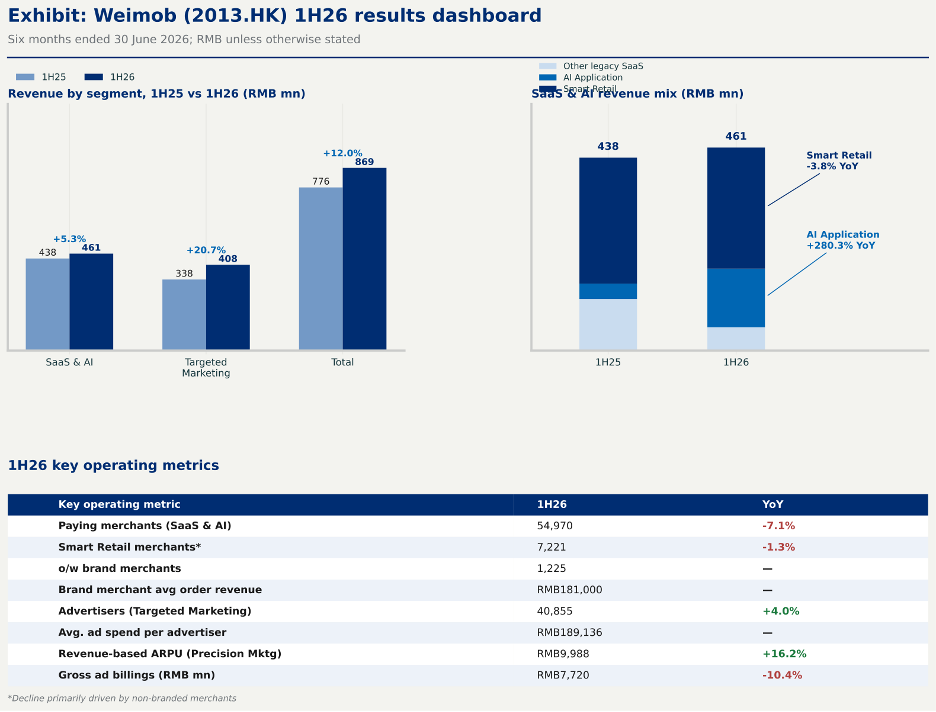
Weimob runs two segments with different economics, now relabelled by management itself. Subscription Solutions is now reported as "SaaS and AI." Merchant Solutions is now "Precision Marketing."

Business Model
1. Weimob runs two economically distinct businesses under one roof: SaaS and AI, and Precision Marketing. Each has a different moat, a different margin structure, and a different risk.
2. SaaS and AI sell merchants a home base they own, in a market of stalls they rent. Marketplaces provide traffic but retain control of discovery, transaction economics, and much of the customer relationship. WeChat private-domain commerce instead allows merchants to build and re-engage an owned customer base through Mini Programs, Official Accounts, WeCom, membership, and CRM. Weimob sells the software layer supporting those workflows.
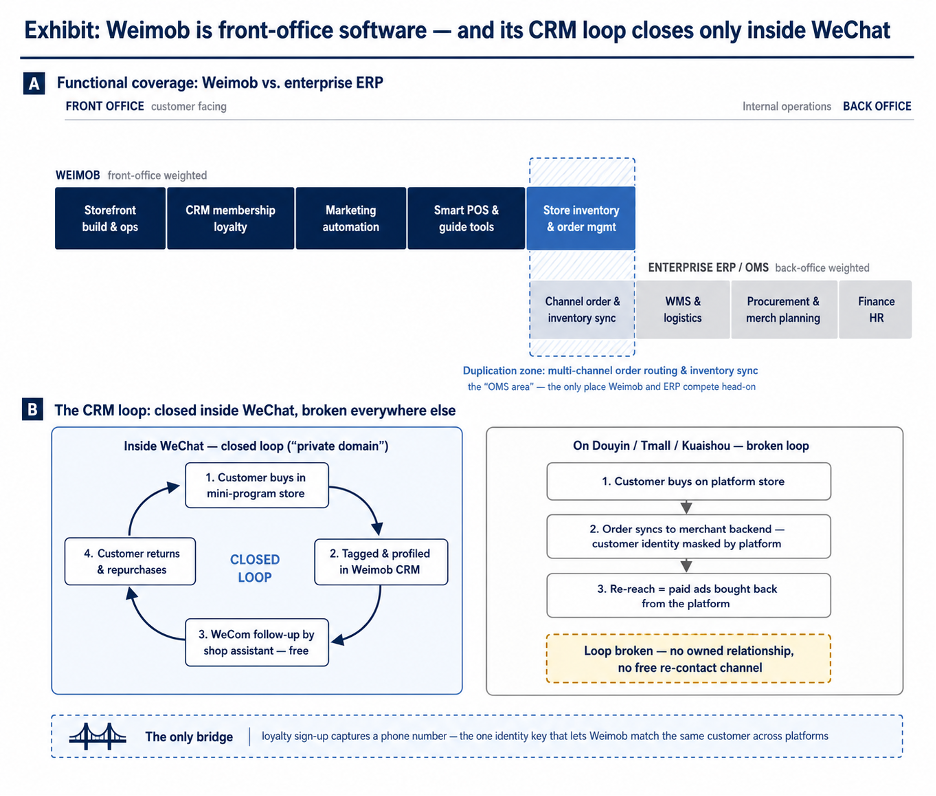
Smart Retail monetises this through three capabilities. Multi-channel order and inventory sync, on a store-node model, covers Tencent rails deepest. Private-domain management moves customers from public platforms into WeChat via QR codes and loyalty tools. A CRM closed loop tags each customer at purchase, routes follow-up through a sales associate on WeCom, and drives repeat visits. The pitch is cost arithmetic. Tmall replaced its RMB30–60K annual fee with a 0.6% transaction fee plus 2–5% category commissions in September 2024. Weimob's entry subscription starts around RMB6,800 a year. Past a modest GMV threshold, fee savings alone pay for the software.
Smart Retail's mix jump to 67% of segment revenue in 2025 from 45% in 2023 was a denominator story, not a growth story. Smart Retail revenue was down 2% over the period. The rest of the subscription book fell by a third. By H1 2026, that mix has reversed to 60%, because AI revenue is now growing fast enough to dilute Smart Retail's share from the other direction.Smart Retail cohort trends are mixed. Brand-merchant count and spend remain below prior peaks, while non-branded merchant growth has come with limited ARPU progression. The data suggests that Weimob has not yet translated its enterprise focus into sustained expansion in its highest-value cohort
Smart Retail's mix jump to 67% of segment revenue in 2025 from 45% in 2023 was a denominator story, not a growth story. Smart Retail revenue was down 2% over the period. The rest of the subscription book fell by a third. By H1 2026, that mix has reversed to 60%, because AI revenue is now growing fast enough to dilute Smart Retail's share from the other direction.
3. Precision Marketing is a platform-rebate distribution business. Weimob acquires advertisers and executes campaigns across major platforms, earning the spread between platform rebates and client economics. Its reported margin depends heavily on product mix, rebate terms, and platform policy rather than proprietary control over inventory or pricing.
Exit of low margin businesses. Weimob wound down its low-margin TSO and credit-tech books in 2024–25, leaving Merchant Solutions almost purely high-margin net rebate revenue.
4. AI is an integration-led product layer, not a proprietary-model advantage. Weimob orchestrates third-party models across content creation, merchant workflows, enterprise customisation, and storefront publishing; its potential differentiation lies in workflow design, merchant data connections, and WeChat integration. AI Application revenue reached RMB133m in H1 2026, above RMB116m in FY2025, but its 13.8% gross margin was far below SaaS Products’ 64.0%. As a result, AI growth supported segment revenue while reducing SaaS and AI gross margin from 62.6% to 49.5%. The key question is whether AI can improve retention and ARPU enough to justify its current dilution of blended margin.
Value Proposition & Market Analysis
Private domain sales is small relative to public marketplaces. WeChat Stores and Video Accounts commerce reached roughly RMB0.4tn in 2025. The top five public marketplaces — Alibaba, Pinduoduo, JD, Douyin and Kuaishou — still capture over 90% of public-platform transactions.
The economics behind this are real and large.
- Customer acquisition costs. Public-domain customer acquisition costs roughly RMB1,088 per customer. Private-domain acquisition costs RMB30–60. That's a 20–35x gap, and it's the actual product being sold — not the storefront itself. Conversion-rate comparison sometimes cited alongside this stat (0.37% vs. 6–10%).
- Take-rate arbitrage. Smart Retail shifts repeat sales from marketplaces charging a 5–25% effective take to WeChat private domain at ~0.6% payment cost. A merchant should subscribe only where fee savings exceed the software fee. At a 5% take rate, that's ~RMB4M of annual private-domain GMV for a brand merchant (RMB183K fee) and ~RMB1M for a non-branded merchant (RMB58K fee). These thresholds define the addressable pool.
Weimob's sweet spot is narrow and specific. It's the offline-heavy retail chain running a private-domain strategy: high GMV, real willingness to pay, workable LTV/CAC. Where a merchant's center of gravity is platform e-commerce — heavy Tmall/JD/Douyin volume, multi-warehouse fulfilment — the ERP stays the system of record. Weimob, if present at all, is bolted on as the private-domain module. The right base for the addressable market is therefore merchants with complex omnichannel needs, pursuing a private-domain strategy, for whom Weimob becoming the operational hub is actually plausible.
Addressable SaaS pool: approximately RMB4–9bn. I estimate a branded Smart Retail opportunity of RMB0.9–1.5bn, based on 5,000–8,000 multi-store brands with sufficient private-domain GMV to justify enterprise software spend. The non-branded opportunity is larger, at RMB3.5–7bn, but more assumption-sensitive because it depends on the share of private-domain merchants with physical-store and omnichannel needs. Weimob’s theoretical whitespace is therefore substantial, but its obtainable share is constrained by incumbent ERP/OMS vendors, vertical software, native platform tools, and merchant willingness to operate private-domain commerce at scale.
Precision Marketing: a large market with low-quality, and now deteriorating, economics. FY2025 gross billing fell 7.3% to RMB16.69bn while China's e-commerce advertising pool grew to ~RMB280bn — 38.6% of the RMB725.7bn internet ad market, itself up 11.5%, with e-commerce category ads specifically up 15.6%. Weimob's implied share of the pool fell from ~7.4% to ~6.0% — the first year throughput shrank while the market it serves grew. H1 2026 shows the decline accelerating, not stabilising: gross billing fell 10.4% YoY to RMB7.72bn, a worse rate than FY2025's. Paying merchant count is a partial offset, up 4.0% to 40,855, with ARPU stabilising around RMB189K per management's own characterisation.
The structural limitation matters more than the share loss. Segment economics are set by platform rebate policy, advertising-market conditions, client credit quality and business mix — none of which Weimob controls. One genuine positive: net working capital associated with the advertiser book has been negative since FY2024, meaning the segment doesn't need incremental cash to fund its own gross margin growth. That's real capital efficiency. It does not offset the segment's complete absence of pricing power, and it doesn't change the fact that billing — the actual throughput this business depends on — is now shrinking faster than a year ago.
Strategy
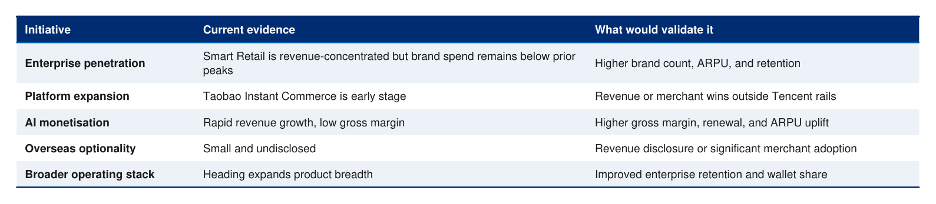
Management's plan has five pillars. Two are proven; three are early or unproven.
Business Moats & System View
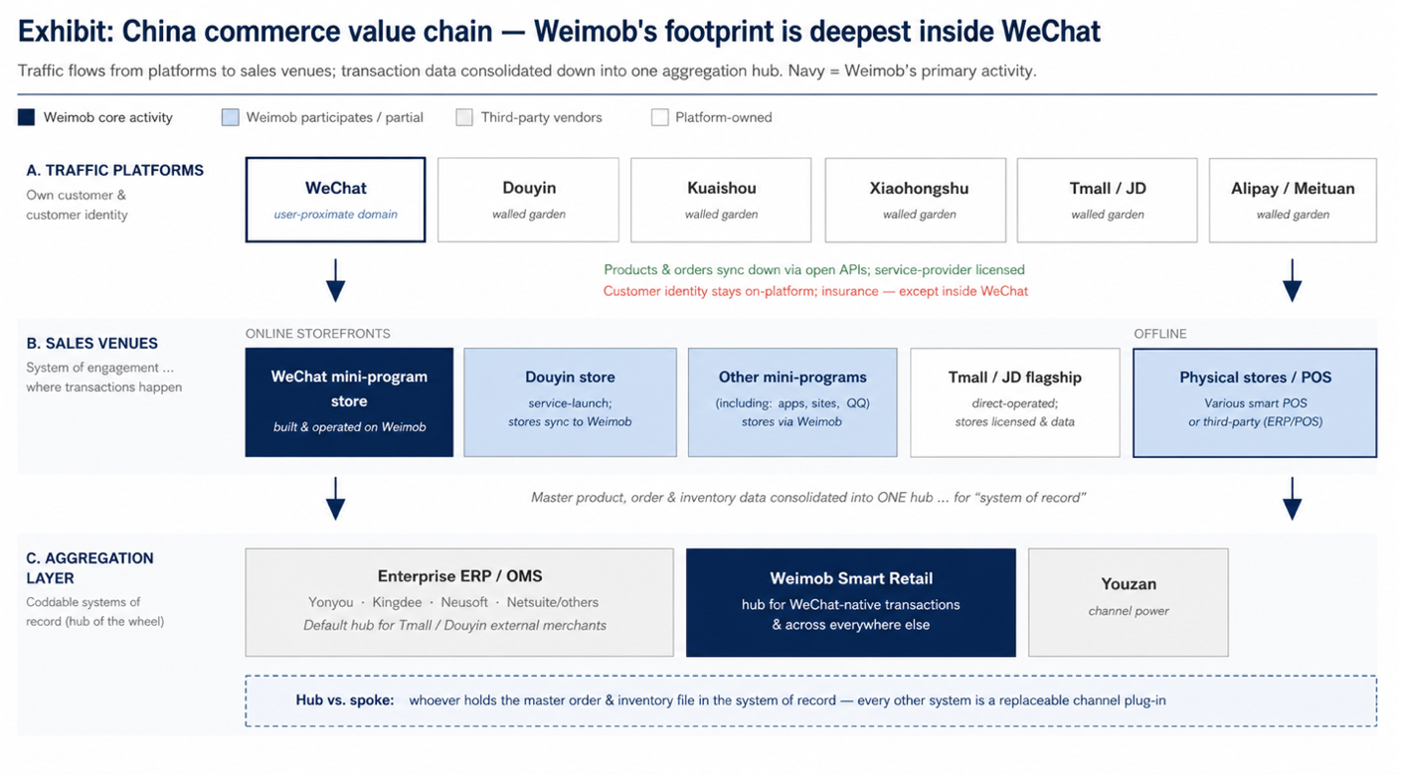
1. The central question is whether Weimob is the hub of a merchant's operations or merely a spoke. A hub is the system everything else is wired into — removing it means rewiring the entire operation, which creates real switching costs. A spoke is a module that plugs into someone else's hub and can be swapped out — for Youzan, an agency, or an in-house team — without the rest of the business noticing. Durable moats require hub status. Weimob is plausibly the hub for WeChat-centric merchants and merely a spoke for merchants whose center of gravity is Tmall, Douyin, or their own ERP.
2. The hub role is won by adoption, not capability. Four forces work against Weimob winning it for most large merchants:
Coverage gaps. Weimob's integrations run deepest on WeChat, plus a subset of channels. Tmall and JD — the biggest venues for most consumer brands — belong to dedicated OMS/ERP vendors like Jushuitan and Wangdiantong, with older, deeper integrations. A hub with incomplete coverage is less likely to be selected as the merchant’s system of record, particularly where Tmall, JD, fulfilment, and ERP integration remain operationally critical.
Incumbency. The hub decision is usually made years before Weimob arrives. Weimob enters as "the WeChat vendor" and plugs into an existing system. Promoting a spoke to hub means rip-and-replace of the operational core — merchants rarely do this voluntarily.
Product depth. Hub status needs warehouse management, procurement, financials integration. Weimob's stack is front-office weighted by design.
Buying logic. Merchants buy Weimob for the WeChat private domain specifically. If WeChat dominates sales mix, Weimob-as-hub is natural. If Tmall is 60% of sales, Weimob stays a spoke.
3. Sequence matters as much as capability. A merchant that starts on WeChat and extends outward treats Weimob as the brain first — sticky, because the private-domain relationship predates any platform dependency. A merchant that starts on a public platform and adds Weimob later treats it as just another tool — replaceable, because the customer relationship never lived inside Weimob to begin with.
4. On balance: SaaS and AI has a narrow, execution-based moat, not a broad structural one. Its real advantage is WeChat-based workflows for complex merchants. That advantage weakens outside WeChat, where Weimob is closer to an ad-execution intermediary and lock-in is weaker. The January 2026 Taobao Instant Commerce agreement tests whether this changes — but it's early-stage and explicitly exploratory, not evidence of a platform-agnostic system yet.
5. Evidence check. Smart Retail brand count and revenue have not yet demonstrated the expansion expected of a strengthening enterprise moat. The strategy remains plausible, but it has not been validated in the reported cohort data.
6. Platform and private-domain risk. Weimob’s differentiation rests on merchants viewing ownership of WeChat customer relationships as sufficiently valuable to justify paid software. That proposition weakens if merchants favour public marketplaces and retain an ERP as their operating core, or if Tencent’s native tools, platform policy, APIs, traffic allocation, or commercial terms reduce the value of third-party integration. Weimob’s core proposition is therefore both merchant-behaviour dependent and built on Tencent-controlled rails.
7. AI lowers barriers at the low end. Because Weimob relies on third-party models, basic content, customer-service, and storefront functions may become easier to replicate. Its remaining defense is workflow integration and merchant-specific operational data, particularly for complex multi-store customers; the economic evidence is assessed in the Business Model section.
8. Precision Marketing has limited structural protection. Advertisers can use competing agencies or platform-native tools, while Weimob does not control media inventory, algorithmic distribution, or rebate policy. Its economic quality should therefore be judged primarily through gross-billing retention and cash conversion, rather than reported segment margin.
9. The two segments are coupled, not independent. They share a customer base and a common objective: converting public traffic into owned WeChat relationships.
When private-domain conversion works, the effect on Precision Marketing is ambiguous. Less need for repeat paid traffic is a headwind for billing; but proof that the ecosystem generates real commerce value supports Weimob's standing with Tencent. Direction isn't obvious and likely varies by cohort.
When conversion fails, the loop is one-directional and worse. A merchant that can't make private domain work has less reason to pay for SaaS and AI — but likely keeps or increases ad spend, reallocating toward paid traffic instead. This would show up as continued tail attrition alongside resilient or growing Precision Marketing billing, making the business look healthier than the core thesis actually is.
10. This is a reason for skepticism about segment metrics in isolation. Stable or growing Precision Marketing revenue doesn't validate the private-domain thesis — it may just as easily reflect merchants giving up on it. Subscription retention and repeat-purchase data should carry more weight than Precision Marketing billing when judging whether "own your customers" is actually working.
A Systems View: What's Reinforcing, What's Self-Limiting
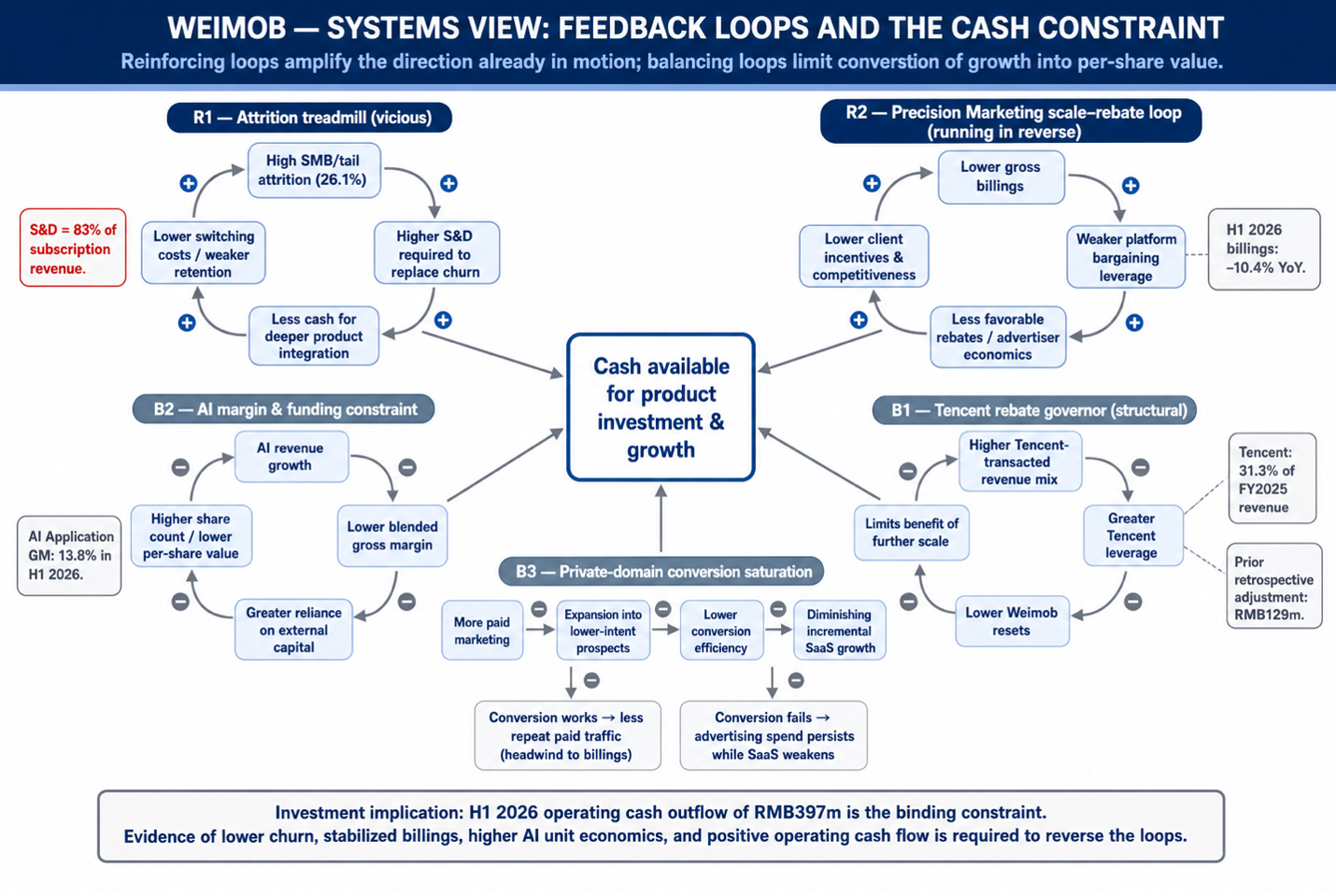
Weimob’s operating issues are linked rather than independent. The diagram below shows two reinforcing loops currently moving in the wrong direction and several constraints that limit management’s ability to reverse them.
R1: Attrition treadmill. High SMB attrition requires significant replacement S&D, leaving less capital to deepen integration and raise switching costs. The result is a potentially self-reinforcing cycle of weaker retention and continued sales intensity.
R2: Scale–rebate loop. Falling gross billings may reduce Weimob’s negotiating leverage with platforms and advertisers, which could weaken commercial terms and further impair billing growth. This remains a relationship to monitor rather than a proven causal outcome.
Cash is the binding constraint. H1 2026 operating cash flow of negative RMB397m matters because product investment, merchant acquisition, and working-capital needs all compete for the same funding base. The investment case improves only if Weimob can redirect cash toward retention and productive growth without recurring dilution.
Key Financials
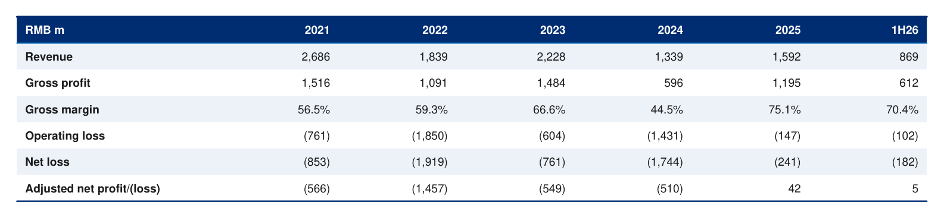
FY2025 was a cost-led improvement, not proof of operating leverage. Revenue rose 18.9% to RMB1.59bn and adjusted net profit turned positive at RMB42m, but the improvement was driven largely by the absence of prior impairment charges and lower operating costs: S&D fell 23% and G&A 27%. Revenue remained 41% below its 2021 peak, albeit after the exit of certain business lines.
H1 2026 weakened the recovery case. SaaS and AI revenue grew 5.4%, but paying merchants fell 7.1% to 54,970 and Smart Retail revenue declined 3.8%. Precision Marketing revenue rose 20.9%, yet gross billings fell 10.4% to RMB7.72bn, widening the gap between reported revenue and underlying throughput. Together with a RMB397m operating cash outflow, these metrics indicate that improved accounting profitability has not yet translated into durable economic progress.
The balance sheet is thinner than the headline cash figure suggests. Cash and deposits fell to RMB1.995bn from ~RMB2.1bn at FY2025-end, consistent with the H1 2026 operating outflow and only partly offset by February 2026 placement proceeds. Of the RMB2.0bn on the balance sheet on June 30, 2026, RMB539m was restricted, leaving roughly RMB1.46bn freely available — against RMB2.18bn of bank borrowings.
Valuation
Valuation remains balance-sheet anchored until the operating business proves sustainable cash generation. Weimob has not yet demonstrated durable SaaS growth, stabilising gross billings, free-cash-flow conversion, or returns above its cost of capital. The following values are therefore reference points rather than a conventional earnings-based target price.
Segregating operating assets from non-operating liquidity. Approximately 39% of total assets — RMB1.995bn of cash and bank deposits and RMB918.7m of long-term investments (equity-method stakes and non-current financial assets) — sits outside the core commerce-software operating business.
NAV. Using H1 2026 total assets of RMB7.44bn, less intangible assets of RMB0.80bn, less total liabilities of RMB4.65bn, tangible net assets are RMB1.99bn. Divided by the current 4.13bn shares outstanding and converted at 1.16 CNY/HKD, this yields an indicative tangible asset-value floor of approximately HK$0.56 per share — below the current HK$1.00 share price.
A haircut-adjusted bear case. Applying an illustrative 50% haircut only to the RMB918.7m of long-term investments (largely minority stakes with limited disclosed liquidity) reduces tangible net assets to roughly RMB1.53bn, or approximately HK$0.43 per share — a ~57% discount to the current price. Even on this more conservative treatment of working capital, the asset floor sits meaningfully below where the stock trades today.
At the current share price, the investment case cannot rely on asset value alone. Upside requires evidence that SaaS retention improves, Precision Marketing billings stabilise, AI economics improve, and operating cash flow turns sustainably positive. Until then, the shares remain a Hold/Watchlist rather than an asset-backed recovery opportunity.